· Savvy Team
Dubai Is Launching Electric Buses: How Will They Be Charged and Who Will Charge Them?
Dubai's electric bus rollout is more than a vehicle upgrade — it's a major charging infrastructure challenge. Here's how the buses will be charged, who's involved, and what it means for commercial fleets.
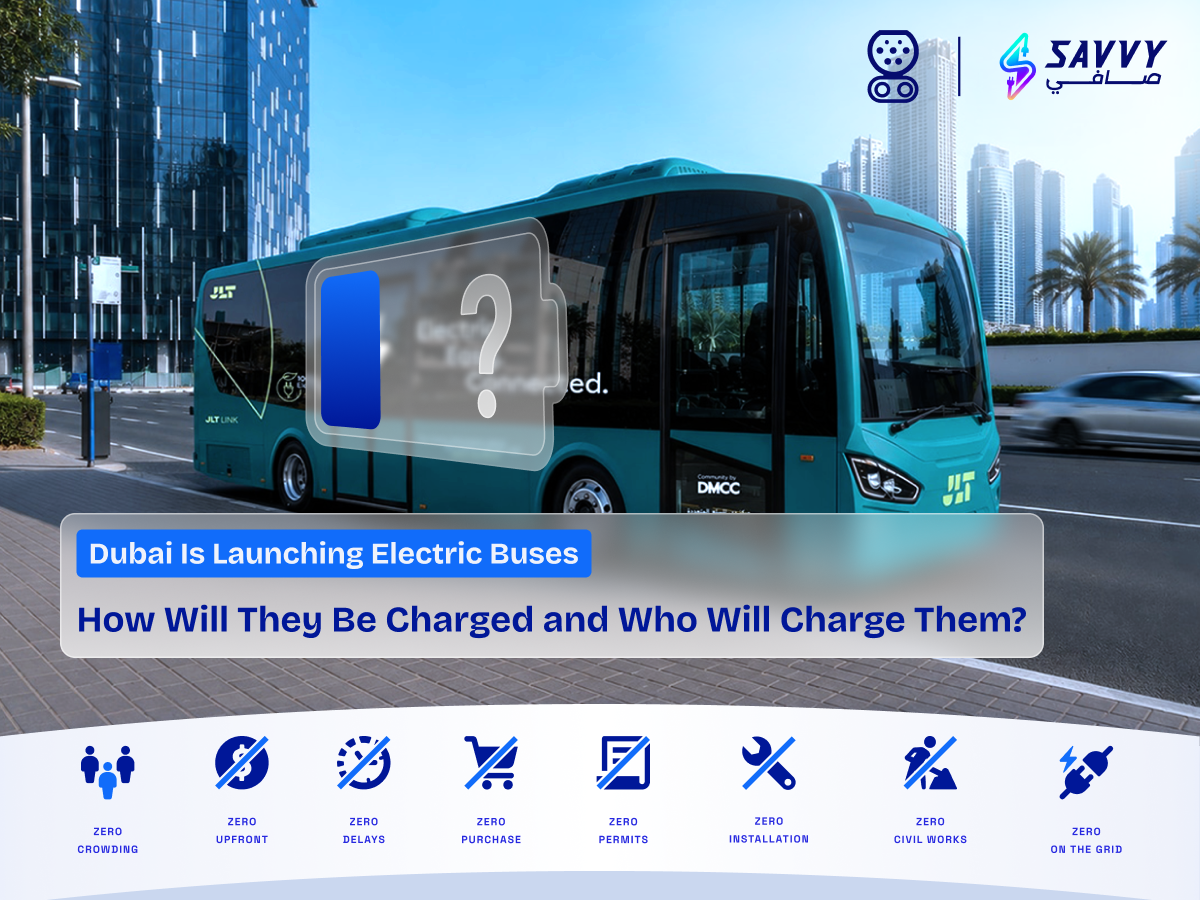
Dubai's public transport network is entering a new chapter. As part of its long-term sustainability strategy, the emirate is accelerating the adoption of electric buses to reduce transport emissions, improve air quality, and support the UAE's Net Zero 2050 ambitions. While replacing diesel buses with battery-electric models is a significant milestone, the vehicles themselves represent only one part of a much larger transformation.
Behind every electric bus lies a sophisticated energy ecosystem involving charging infrastructure, electricity grids, energy storage, software, and fleet management. Procuring electric buses is relatively straightforward; ensuring they operate reliably every day across a rapidly growing city is the real engineering challenge.
This transition comes at a time when electricity demand is increasing across multiple sectors. Artificial intelligence (AI) data centres, electric vehicles, industrial electrification, and smart city initiatives are all competing for greater grid capacity. According to the International Energy Agency (IEA), global data centre electricity consumption is projected to exceed 945 TWh by 2030, while BloombergNEF forecasts continued growth in EV adoption worldwide. Cities must therefore expand not only their transport networks but also the energy infrastructure supporting them.
For Dubai, the question is no longer whether electric buses will become part of the city's future—they already are. The bigger question is how they will be charged, who will manage that infrastructure, and whether the existing power network is ready for large-scale fleet electrification.
Key Takeaways
- Dubai's electric bus programme supports the RTA Zero-Emissions Public Transportation Strategy 2050 and the UAE Net Zero 2050 initiative. - Charging infrastructure—not the buses themselves—is likely to be the biggest operational challenge. - Depot charging, DC fast charging, pantograph systems, and AI-powered energy management will all play important roles. - Public agencies, utilities, and private charging providers will work together to build the charging ecosystem. - Flexible commercial EV charging solutions will become increasingly important as commercial fleet electrification expands beyond public transport.
Dubai's Electric Bus Initiative: Why Public Transport Is Going Electric
Dubai has spent the past decade investing in smart mobility, renewable energy, and sustainable urban development. Electrifying public transport represents another major step in that journey.
Under the RTA's Zero-Emissions Public Transportation Strategy 2050, Dubai aims to transition its public transport fleet towards zero-emission technologies while supporting the broader objectives of the UAE Net Zero 2050 Strategy. The initiative extends beyond environmental responsibility—it is also designed to improve long-term operational efficiency, reduce fuel dependency, and position Dubai as a global leader in sustainable urban mobility.
The scale of these ambitions is significant. According to the RTA, the strategy targets the elimination of approximately 10 million tonnes of CO₂ emissions by 2050 while generating an estimated AED 3.3 billion in lifecycle savings compared with conventional transport operations. Fleet electrification is expected to progress in phases, with zero-emission buses gradually increasing over the coming decades before reaching full deployment by 2050.
Dubai is far from the only city pursuing this transition. Shenzhen has already electrified its entire public bus fleet, London continues expanding zero-emission routes, and Singapore is investing heavily in electric public transport. However, Dubai's approach is distinctive because it aligns fleet electrification with investments in AI, renewable energy, and smart city infrastructure, creating a more integrated model for future urban development.
Electric buses are also a logical starting point for large-scale electrification. Unlike private vehicles, buses operate on fixed routes, predictable schedules, and centralised depots, making charging infrastructure easier to plan and optimise. This operational predictability allows transport authorities to maximise charger utilisation, schedule overnight charging, and integrate energy management systems more effectively than many other transport segments.
However, replacing diesel engines with batteries introduces a completely different set of infrastructure requirements—ones that extend well beyond simply installing chargers.
Why Charging Infrastructure Matters More Than the Buses Themselves
The success of an electric bus network depends less on the vehicles and more on the energy ecosystem supporting them.
Modern battery-electric buses typically carry battery packs ranging between 300 and 600 kWh, depending on vehicle size and route requirements. To put this into perspective, a single fully charged bus can consume roughly the same amount of electricity as an average household uses over several weeks. Multiply that across an entire depot, and the scale of energy demand becomes substantial.
A depot housing 100 electric buses may require several megawatts of connected electrical capacity—comparable to the demand of a medium-sized industrial facility. Without intelligent charging strategies, simultaneous charging could create significant peak electricity loads, increasing infrastructure costs while placing unnecessary pressure on local distribution networks.
This is why charging infrastructure has become a strategic planning exercise rather than a simple equipment purchase.
Transport operators must consider transformer capacity, substation upgrades, charger placement, cable routing, load balancing, software integration, and future fleet expansion years before additional buses enter service. Smart charging platforms are increasingly being deployed to stagger charging schedules, prioritise vehicles based on departure times, monitor battery health, and minimise electricity costs by charging during off-peak periods whenever possible.
Reliability is equally important.
Unlike passenger vehicles, public buses operate according to strict timetables where even minor disruptions can affect thousands of commuters. A charging system failure is therefore not simply an operational inconvenience—it has the potential to impact the entire transport network. Charging infrastructure must deliver the same level of reliability expected from the buses themselves, making redundancy, remote monitoring, predictive maintenance, and resilient power management essential components of fleet operations.
As Dubai expands its electric bus programme, the conversation is therefore shifting beyond vehicle procurement towards a much broader question:
What combination of charging technologies, energy providers, and infrastructure partners will be required to keep an increasingly electrified public transport system moving every day?
How Are Electric Buses Charged? Understanding the Technologies Behind Fleet Electrification
Unlike passenger EVs, electric buses rarely rely on a single charging method. Instead, fleet operators combine multiple technologies based on route length, depot operations, vehicle utilisation, and daily energy demand.
Depot charging remains the foundation of most public transport fleets. Buses return to central depots after completing daily routes and are typically charged overnight using AC or DC chargers when electricity demand is lower. This approach simplifies fleet management while allowing operators to take advantage of lower off-peak electricity tariffs.
For high-frequency routes, DC fast charging provides rapid energy replenishment between service intervals. Chargers rated between 150 kW and 350 kW can significantly reduce downtime, allowing buses to return to service quickly without remaining connected for extended periods.
Many cities are also adopting pantograph opportunity charging, where an overhead charging arm automatically connects to the bus at major terminals or route endpoints. Delivering several hundred kilowatts of power within minutes, these systems extend vehicle range without requiring oversized battery packs, making them particularly attractive for intensive urban operations.
Behind these physical chargers sits another critical layer: smart energy management software. Modern fleet platforms analyse route schedules, electricity prices, battery health, and charger availability in real time, ensuring that every bus receives the energy it needs while avoiding unnecessary strain on the electricity network. As fleets continue to grow, this software will become just as important as the charging hardware itself.
Who Will Charge Dubai's Electric Bus Fleet?
Charging Dubai's next generation of electric buses will not be the responsibility of a single organisation. Instead, it will require a coordinated ecosystem involving public authorities, utilities, charging infrastructure providers, and technology partners.
At the centre of this ecosystem is the Roads and Transport Authority (RTA), which oversees fleet procurement, route planning, depot operations, and long-term electrification strategy. However, ensuring buses have reliable access to electricity requires close collaboration with Dubai Electricity and Water Authority (DEWA), which is responsible for supplying power, expanding grid capacity, and supporting the emirate's charging infrastructure.
Dubai's charging landscape is also evolving. Through DEWA's Charge Point Operator (CPO) licensing framework, private companies can now participate in building and operating EV charging infrastructure. This public-private collaboration enables specialised charging providers to deploy and manage charging stations while maintaining technical and operational standards established by DEWA.
Beyond physical charging equipment, fleet operators will increasingly rely on energy management platforms that optimise charging schedules based on bus timetables, electricity tariffs, battery health, and depot capacity. Rather than charging every vehicle immediately after returning to the depot, intelligent software can stagger charging sessions to reduce peak demand and improve overall energy efficiency.
Charging an electric bus fleet, therefore, is no longer simply an electrical task—it is becoming an integrated energy management operation involving utilities, software, infrastructure providers, and transport authorities working together.
Is Dubai's Power Grid Ready for Large-Scale Electric Bus Charging?
Dubai's electricity network is among the most advanced in the region, but electrifying hundreds—and eventually thousands—of buses introduces a new category of energy demand.
Unlike residential or commercial charging, bus depots create highly concentrated electricity loads. A large depot charging dozens of buses simultaneously can require several megawatts of connected capacity, placing significant pressure on local substations and distribution infrastructure if charging is not carefully managed.
To prepare for this transition, DEWA continues investing in grid modernisation, renewable energy integration, and smart grid technologies. A major contributor is the Mohammed bin Rashid Al Maktoum Solar Park, one of the world's largest single-site solar projects, which plays a growing role in supporting Dubai's clean energy ambitions.
Battery Energy Storage Systems (BESS) are also expected to become increasingly important. Instead of drawing maximum power directly from the grid during peak periods, depot batteries can store electricity during off-peak hours—or from renewable generation—and discharge it when buses require high-power charging. This approach reduces stress on local infrastructure while improving energy resilience and lowering operating costs.
Looking further ahead, technologies such as Vehicle-to-Grid (V2G) could transform electric buses into distributed energy assets. During periods of peak electricity demand, parked buses may eventually return stored energy to the grid, helping stabilise electricity networks while creating additional value for fleet operators.
The challenge facing Dubai is therefore not simply producing enough electricity—it is ensuring that electricity is delivered efficiently, intelligently, and sustainably where fleet operators need it most.
Can Off-Grid and Mobile Charging Support Dubai's Growing Electric Bus Network?
Although permanent charging depots will form the backbone of Dubai's electric bus network, they may not be the ideal solution for every operational scenario.
Fleet expansion often happens faster than utility infrastructure. New routes, temporary depots, major infrastructure projects, and special events may require charging solutions long before permanent grid upgrades can be completed. Waiting months—or even years—for additional electrical capacity can delay fleet deployment and reduce operational flexibility.
This is where battery-backed and off-grid charging solutions become increasingly valuable.
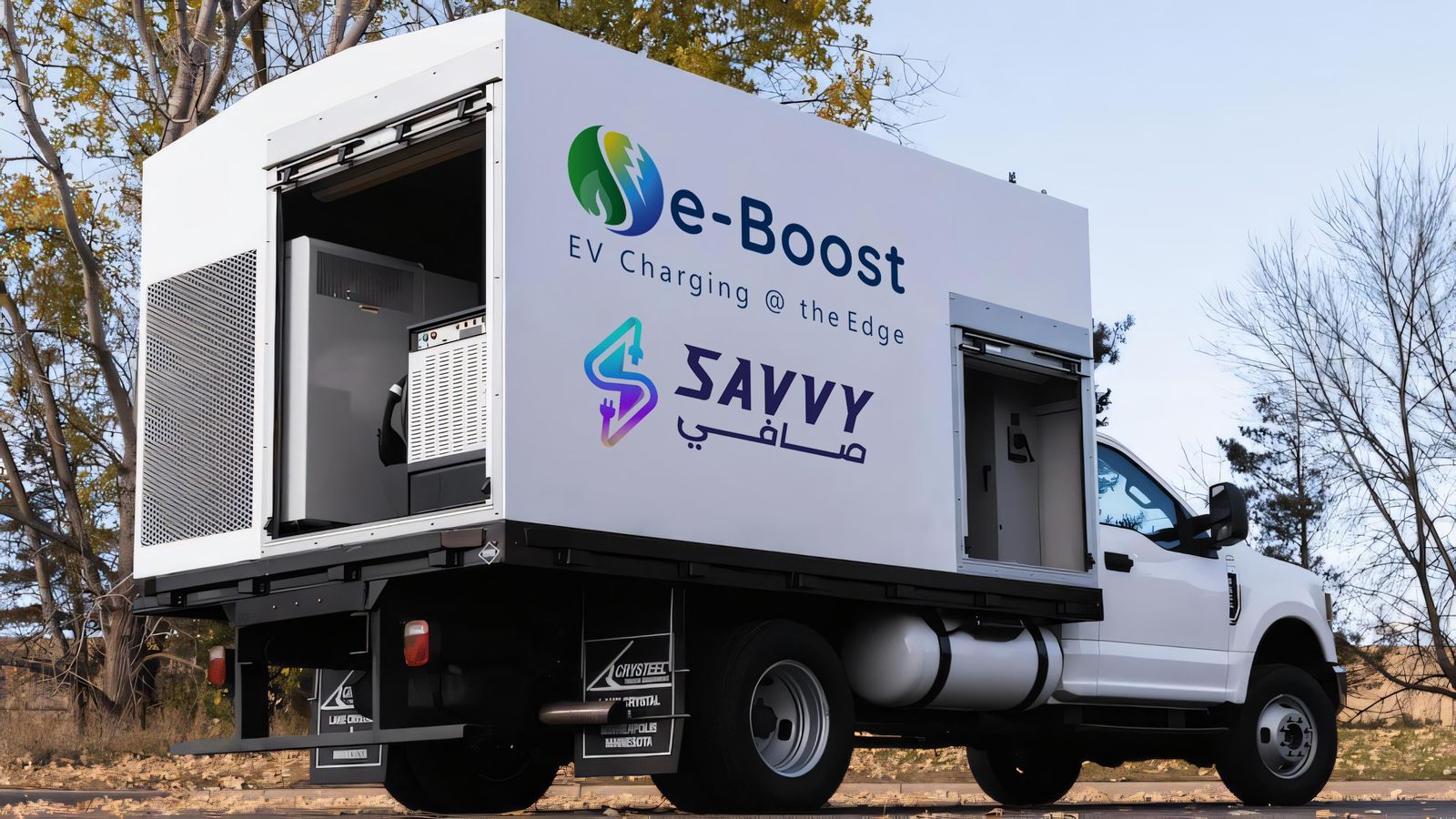
Instead of relying exclusively on high-capacity grid connections, businesses and transport operators can deploy off-grid EV charging systems that integrate Battery Energy Storage Systems (BESS), intelligent power management, and fast DC charging. These systems can be installed rapidly, relocated when operational requirements change, and deployed in locations where conventional infrastructure is either unavailable or still under development.
Mobile EV charging offers another layer of resilience. In the unlikely event of unexpected range depletion, depot maintenance, or emergency service disruptions, mobile charging units can provide temporary charging support without affecting the wider transport network. They can also support pilot programmes, remote routes, and temporary operational hubs while permanent charging infrastructure is being constructed.
Rather than replacing conventional charging stations, these flexible solutions complement them by reducing infrastructure bottlenecks and improving business continuity.
What Dubai's Electric Bus Transition Means for Commercial Fleet Electrification
The infrastructure being developed for Dubai's electric buses will have implications well beyond public transport.
Once cities establish reliable charging ecosystems capable of supporting heavy-duty public fleets, the same infrastructure can accelerate electrification across logistics, municipal services, airports, ports, school transport, construction, and last-mile delivery operations.
Commercial fleet operators face many of the same challenges as public transport authorities: managing charging schedules, reducing downtime, controlling energy costs, and ensuring operational reliability. Lessons learned through Dubai's electric bus rollout will therefore influence how businesses approach fleet electrification over the coming decade.
Many organisations are already investing in commercial EV charging solutions that combine charging hardware with intelligent software, energy management, and scalable infrastructure planning. As commercial fleets continue to expand, charging will increasingly be viewed not simply as an operational requirement but as a strategic business capability.
For sectors operating across multiple locations or temporary sites, combining conventional charging with battery-backed and distributed energy solutions will provide greater resilience while reducing dependence on lengthy utility upgrades.
Building the Infrastructure Behind Dubai's Electric Bus Future
Dubai's transition to electric buses represents far more than the replacement of diesel vehicles with battery-powered alternatives. It marks the beginning of a broader transformation in how public transport is powered, managed, and integrated into the city's evolving energy ecosystem.
While the buses themselves demonstrate impressive technological progress, the long-term success of the initiative will depend on the infrastructure behind them. Smart charging software, resilient electricity networks, renewable energy integration, battery storage, and flexible charging solutions will all play essential roles in ensuring reliable fleet operations.
As Dubai advances towards its Net Zero 2050 ambitions, charging infrastructure will become just as important as vehicle technology. Cities that invest early in intelligent energy management and resilient charging ecosystems will be better positioned to scale public transport, commercial fleets, and future mobility solutions.
Alongside permanent depot infrastructure, technologies such as on-demand mobile EV charging can provide additional flexibility for temporary operations, emergency support, and infrastructure expansion—helping ensure that fleet electrification continues even as electricity demand grows across the wider economy.
Frequently Asked Questions
How are electric buses charged?
Electric buses are primarily charged using overnight depot charging, high-power DC fast charging, or overhead pantograph systems installed at major terminals. Fleet operators often combine multiple charging methods to maximise operational efficiency.
How long does it take to charge an electric bus?
Charging time depends on battery capacity and charger output. Overnight depot charging typically takes between 4 and 8 hours, while high-power DC chargers can significantly reduce charging time. Opportunity charging systems can deliver rapid energy top-ups in just a few minutes during scheduled stops.
Who will charge Dubai's electric buses?
The charging ecosystem will involve multiple stakeholders, including Dubai's Roads and Transport Authority (RTA), Dubai Electricity and Water Authority (DEWA), licensed Charge Point Operators (CPOs), charging technology providers, and fleet energy management platforms.
Is Dubai's electricity grid ready for electric bus fleets?
Dubai has a robust and continuously expanding electricity network. However, supporting large-scale fleet electrification will require ongoing investment in substations, smart grids, renewable energy integration, Battery Energy Storage Systems (BESS), and intelligent charging management.
Can electric buses be charged off-grid?
Yes. Battery-backed off-grid charging systems can provide high-power charging in locations where permanent grid infrastructure is unavailable, constrained, or still under development. These systems are particularly valuable for temporary depots, remote operations, and infrastructure expansion projects.
Why is battery storage important for electric bus charging?
Battery storage helps reduce peak electricity demand by storing energy during off-peak periods and delivering it when buses require charging. This improves grid stability, enhances energy resilience, and can reduce operating costs for fleet operators.
What does Dubai's electric bus programme mean for other industries?
The infrastructure developed for public transport will support broader fleet electrification across logistics, airports, ports, municipalities, school transport, utilities, and commercial delivery fleets, accelerating the UAE's wider transition towards sustainable mobility.
Tags: electric buses, dubai, rta, dewa, fleet electrification, off-grid charging, uae