· Savvy Team
The Off-Grid Charge: How Mobile EV Charging Became a Global Industry
As EV adoption outpaces grid capacity worldwide, mobile off-grid charging has grown into its own global industry. Here's how the model started in Italy and spread to the US, Europe, India, and the UAE.
The Problem: EVs Are Outpacing the Grid
Electric vehicle adoption is growing faster than the power grid can keep up with. Fleets, delivery companies, and everyday drivers are buying EVs, then finding out that a fixed charging station can take twelve months to five years to install once permitting, utility approvals, and construction are factored in. Utilities weren't built to absorb sudden, concentrated demand like this — a single depot full of electric trucks can draw as much power as a small neighborhood, and upgrading a substation to handle that isn't something that happens overnight, no matter how urgently a fleet needs it.
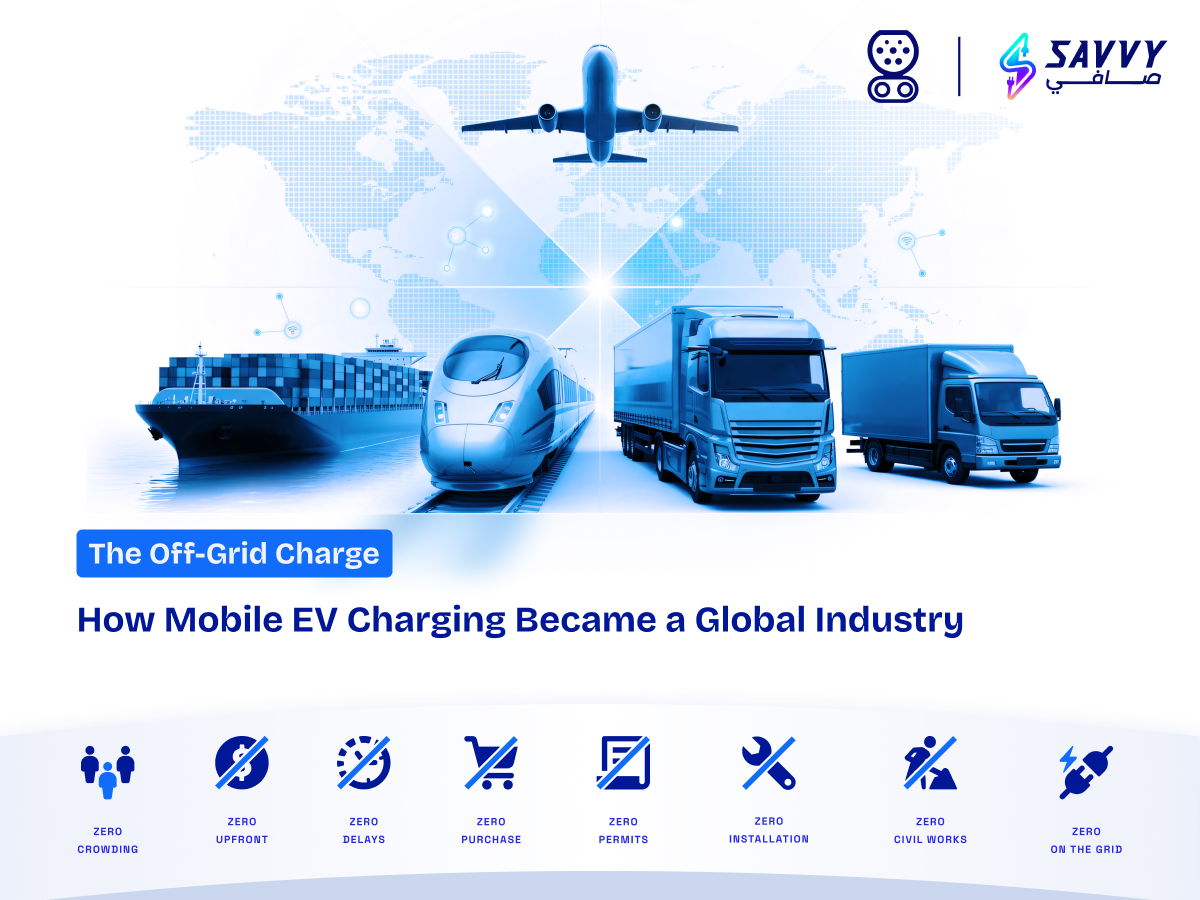
That gap between buying an EV and actually being able to charge it created a new category of company: off-grid, mobile, on-demand EV charging. These providers bring the charger to the vehicle instead of the other way around, using batteries, propane, biogas, or renewable fuel to generate power without any grid connection at all. No major trenching, fewer permitting hurdles, and no months-long wait for a utility connection — just a mobile charger that shows up when it's needed. It's the same basic model that operators from Italy to India have built businesses on, and the one Savvy Charging Technologies now runs in the UAE.
How the Off-Grid Model Started
The idea began in Italy in 2017, when electric vans loaded with battery storage started driving into Milan and Rome to charge parked EVs directly, instead of drivers having to find a station. The model worked well enough that it spread to France, Spain, and Germany within a few years, eventually growing into a fully off-grid, ultra-fast charging format used in projects like the electrification of London's Heathrow Airport.
What made the idea travel so easily is that it didn't require any single piece of specialized technology — just a vehicle, a battery big enough to matter, and a business willing to treat charging as a service rather than a fixed location. That flexibility is exactly why other markets picked up the same idea and reshaped it for their own needs soon after — fuel-delivery apps added EV charging in the Gulf, doorstep charging services launched in India, and telematics-based predictive charging took off in the UK, each one solving a slightly different version of the same underlying problem: too many EVs, not enough places to plug them in.
The Business Model: Pay for Power, Not Equipment
As the hardware matured, so did the business model behind it. A growing number of off-grid providers have shifted from selling charging equipment to service-based models, charging customers for the power they use rather than requiring them to own the infrastructure — an approach usually called Charging-as-a-Service or Power-as-a-Service.
That shift removed one of the biggest barriers to fleet electrification: the upfront cost of building infrastructure. A fixed fast-charging installation can run into six figures once site work, grid upgrades, and permitting are included, and that's before the wait for approvals — and for a fleet operator trying to hit an electrification deadline, that wait can be the difference between a project moving forward or stalling entirely.
Off-grid charging avoids most of that, since the charger counts as a mobile asset rather than fixed infrastructure — the same reasoning Savvy applies in the UAE, pairing mobile charging with battery storage systems so customers get access without paying for equipment upfront.
It also changes who can realistically enter the market. A company that would once have needed years of capital just to build a single charging site can now offer charging as a service almost as soon as it has a working vehicle and a battery pack, which is part of why this industry has grown as quickly and unevenly as it has — new entrants keep showing up in markets that a decade ago would have been considered too small or too remote to bother with.
Off-Grid EV Charging in North America
In the U.S., the pressure has come almost entirely from fleets. School districts, delivery companies, and shared-mobility operators are buying EVs faster than utilities can connect new grid capacity, and that mismatch has pushed off-grid charging into everyday use — ultra-fast chargers keeping school bus depots running while permanent grid connections are still years away, battery-only hubs bringing shared mobility to neighborhoods the grid hasn't reached, and old fuel-delivery fleets rebuilt into rolling mobile superchargers.
One Michigan district became the first in the state to fully retire its diesel buses this way, running its new electric fleet on off-grid power supplied by L-Charge while its utility upgrade was still pending — a deployment that let the district keep more than 4,000 daily student trips running on schedule. Providers across this category, including SparkCharge and Yoshi Mobility, have closed multimillion-dollar funding rounds through 2025 and 2026, a sign that fleets are now building off-grid charging into their electrification plans from the start, rather than treating it as a temporary fix, and that investors increasingly see the model as durable infrastructure in its own right.
Off-Grid EV Charging in Europe
In the UK and across Europe, the problem has been less about fleets and more about the everyday difficulty of finding a working charger. That's produced a few different fixes running side by side: roadside rescue units now stationed at major transit hubs like London Heathrow, catching EVs that simply run out of range; containerized battery systems that skip planning permission entirely, making them viable for construction sites that could never justify a fixed installation; and predictive charging models that track a parked EV's battery remotely and send a technician out overnight, without the driver ever needing to be there — an approach Charge Fairy has extended from passenger cars to electric construction equipment through a pilot with Transport for London, one of several signs that off-grid charging in Europe is expanding beyond passenger vehicles into heavier, harder-to-electrify equipment.
Providers such as ZAPME and Charge Qube have built businesses around the other two problems respectively, each solving a different piece of the same gap between where power is and where it's actually needed, and each expanding steadily across new sites as demand for mobile charging grows alongside EV sales across the continent.
Off-Grid EV Charging in India
India's challenge has been as much about reach and infrastructure availability as it has been about grid capacity. With millions of EVs already on Indian roads and a public charging network that hasn't caught up, a single fixed station can cost several lakh to build even where power is available — a cost that's pushed the market toward smaller, mobile alternatives instead, particularly outside the handful of large metro areas where most fixed infrastructure investment has concentrated so far.
Hopcharge, which built the doorstep charging model this category is now known for in India, recently partnered with Tata.ev to bring its charging vans directly to buyers' homes across the National Capital Region, delivering power to drivers rather than asking them to find a station, and effectively bundling charging access into the car-buying decision itself. Other providers have taken on different pieces of the same problem — reaching Tier 2 and Tier 3 cities where a fixed station doesn't make financial sense, and staying grid-independent in areas where the power supply itself is unreliable — approaches associated with providers such as Mobec and Setrans Mobility respectively, both expanding as EV sales grow beyond India's largest cities.
Off-Grid EV Charging in the UAE
The UAE has moved rapidly from pilot projects toward broader deployment, with off-grid charging becoming part of the country's expanding EV infrastructure ecosystem. Roadside charging networks here have grown into full rescue operations, with one provider, PlusX Electric, having charged more than 6,800 vehicles and rescued over 750 more that ran out of range on the road — alongside other homegrown brands, including CAFU, that have taken similar on-demand models abroad and back again with major automotive partnerships attached.
Alongside operators such as PlusX Electric and CAFU, Savvy Charging Technologies is part of this emerging UAE ecosystem, applying the same mobile, on-demand model to local fleet and charging needs. Government targets are pushing the pace further still — the UAE's Minister of Energy and Infrastructure has stated a goal of 10,000 EV charging stations across the country by 2030, up from under 1,000 in 2023, growth that fixed infrastructure alone can't keep up with on its own and that mobile providers are already helping close.
Where Savvy Charging Technologies Fits In
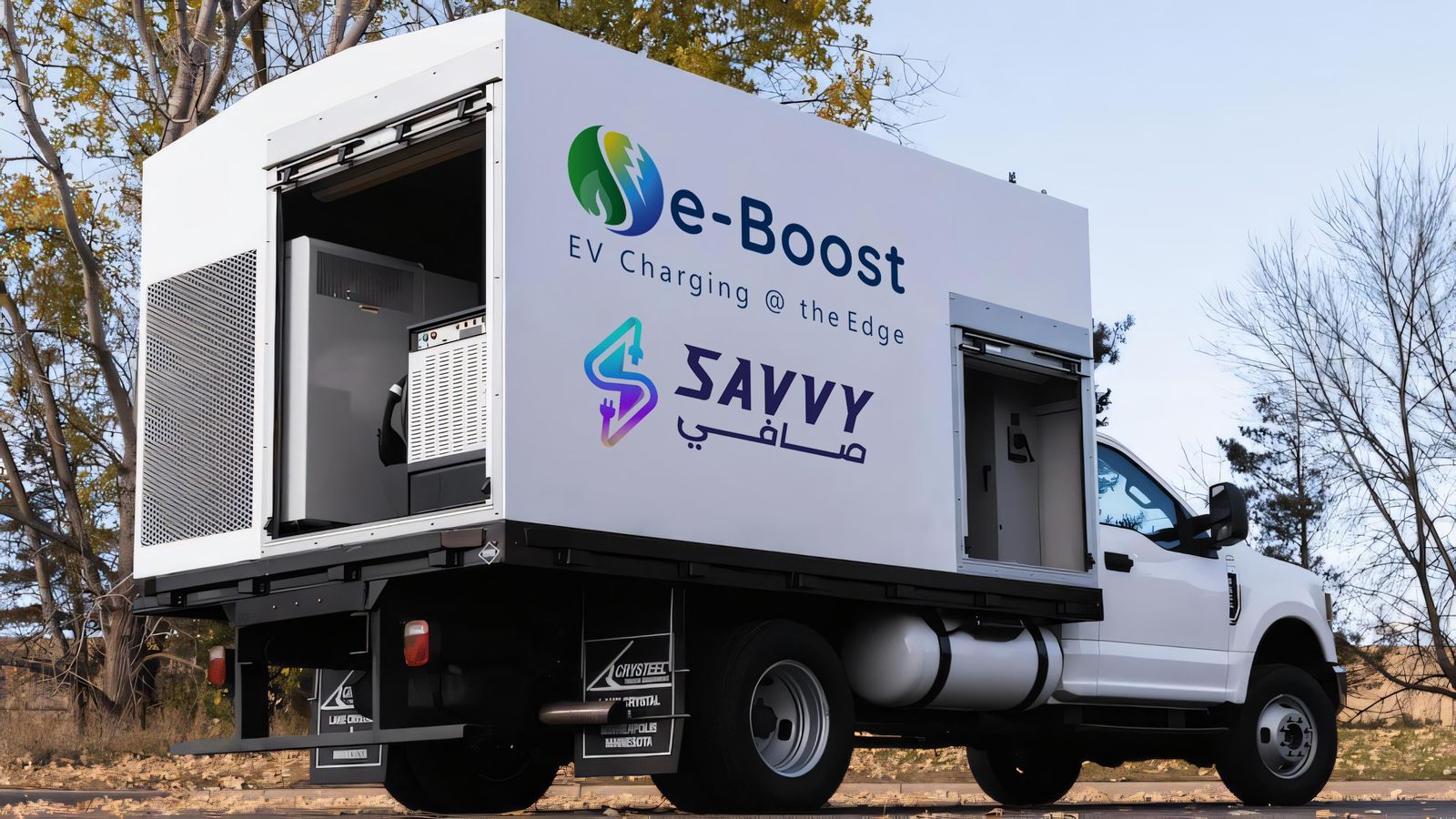
Savvy Charging Technologies, based in Masdar City, Abu Dhabi, is part of that same shift. Request a charge through the app, and someone comes to you, with no grid connection to wait on, no permits, and no installation delay. Savvy charges more than thirty vehicles a day, with a typical session taking around 25 minutes, and supports more than 17 vehicle brands, from mainstream models to premium marques like Tesla, BMW, and Mercedes. It works alongside off-grid technology partners including e-Boost and EVBee, and is backed by institutions including Masdar City and the UAE's Ministry of Industry and Advanced Technology — the same kind of institutional backing that's helped this category scale in every other market covered here.
Conclusion
The same pattern shows up in every region covered here. Before off-grid charging existed, EV adoption kept running into the same three problems: permitting delays, high infrastructure costs, and grid capacity that wasn't built for a sudden surge in electric vehicles. What helped break that bottleneck wasn't waiting for the grid to catch up — it was companies choosing to bring power to where it was actually needed, region after region, each finding its own way to do it. Some built around fleets, some around everyday drivers, some around the sheer geography of reaching places a fixed station could never justify serving — but the underlying bet was the same everywhere: charging doesn't have to be a destination. Savvy Charging Technologies is doing exactly that in the UAE, part of an industry that's already proven the model works.
Frequently Asked Questions
What is off-grid EV charging?
Off-grid EV charging uses mobile chargers powered by batteries, propane, biogas, or renewable fuel to charge vehicles without a grid connection, bringing power directly to the vehicle instead of requiring a fixed charging station.
Why did off-grid charging become popular?
Fixed charging stations can take anywhere from twelve months to five years to install once permitting, utility approvals, and construction are factored in. Off-grid charging skips most of that delay, since the charger is treated as a mobile asset rather than fixed infrastructure.
Where did the off-grid charging model start?
The model began in Italy in 2017, when electric vans loaded with battery storage started charging parked EVs directly in Milan and Rome. It later spread to France, Spain, Germany, the UK, the US, India, and the UAE.
How does the Charging-as-a-Service business model work?
Instead of selling charging equipment, providers charge customers for the power they use, similar to a service subscription. This removes the upfront cost of building fixed infrastructure and lets new providers enter the market faster.
Which industries rely most on off-grid charging?
School districts, delivery fleets, shared-mobility operators, and construction sites are among the biggest users, particularly in regions where grid capacity or permitting delays make fixed stations impractical.
How does Savvy Charging Technologies fit into this industry?
Savvy Charging Technologies operates a mobile, on-demand charging model in the UAE, similar to providers in Italy, the US, Europe, and India. Customers request a charge through the app, and a mobile unit comes to them with no grid connection, permits, or installation delay required.
Is off-grid charging as reliable as fixed charging stations?
Yes. Off-grid providers use battery storage and, in some cases, renewable or alternative fuel sources to deliver consistent charging performance, with typical charging sessions completed in around 25 minutes.
Tags: off-grid charging, mobile ev charging, charge as a service, uae, global ev infrastructure