· Savvy Team
The UK EV Charging Gap: Why Britain's EV Infrastructure Is Entering a Critical Phase
EV adoption in the UK is outpacing charging infrastructure, and grid capacity constraints are now the biggest bottleneck. Here's why off-grid and portable energy solutions are becoming a strategic necessity.
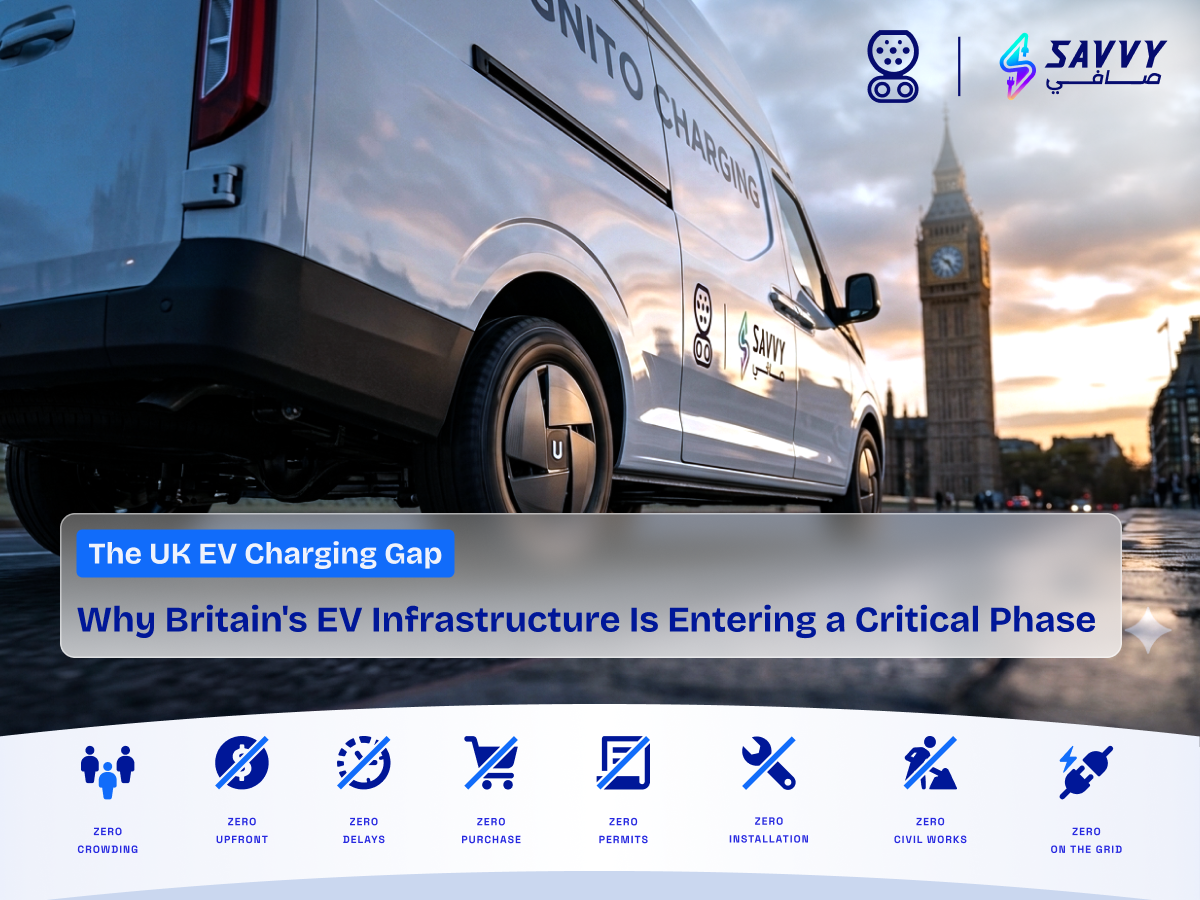
The UK's transition to electric vehicles (EVs) has moved from early adoption to mainstream acceptance. Driven by ambitious decarbonisation targets, expanding vehicle choices, and growing investment from both the public and private sectors, electric mobility is becoming a fundamental part of the country's transport future. Businesses are electrifying commercial fleets, logistics companies are replacing diesel vehicles, and consumers are increasingly choosing battery electric vehicles as charging technology and driving range continue to improve.
This rapid growth has shifted the conversation beyond vehicle adoption.
Today, one of the biggest questions facing the UK is whether charging infrastructure can expand quickly enough to support millions of new EVs over the coming decade. While the country has made significant progress in building one of Europe's largest public charging networks, infrastructure deployment is facing increasing pressure as demand continues to rise.
For organisations planning long-term electrification, charging infrastructure is becoming more than an operational requirement—it is a strategic investment. Businesses are increasingly exploring off-grid energy solutions, Charge-as-a-Service, and portable energy systems to build resilient charging ecosystems that can adapt as energy demand grows.
Understanding the UK's charging gap is essential to understanding the next stage of the country's electric vehicle transition.
The UK's EV Market Is Growing Faster Than Its Charging Infrastructure
The UK is now one of Europe's leading electric vehicle markets.
By mid-2026, more than 2.1 million battery electric vehicles (BEVs) were registered across the country, representing approximately 6.1% of the national vehicle fleet. Continued government support, advances in battery technology, expanding model availability, and stronger sustainability commitments have all contributed to this rapid increase in EV adoption.
Growth is not limited to private motorists.
Businesses across logistics, retail, construction, public services, and corporate transport are steadily electrifying their fleets to reduce emissions and lower operating costs. As more organisations integrate EVs into their operations, dependable charging infrastructure is becoming increasingly important for maintaining productivity and supporting long-term growth.
The UK's public charging network has expanded significantly to meet this demand.
Today, the country has more than 121,000 public EV chargers across approximately 46,700 charging locations. Investment has also shifted towards rapid and ultra-rapid chargers installed at motorway service areas, commercial developments, workplaces, and retail destinations, helping reduce charging times and improve accessibility.
However, deployment is beginning to lose momentum.
During the first half of 2026, around 5,100 new public chargers were installed, representing annual growth of approximately 10%—considerably lower than the expansion rates recorded in previous years.
Although the overall network continues to grow, EV registrations are increasing at a faster pace. This widening gap highlights the need for smarter infrastructure planning alongside continued investment in both public and private charging networks.
Many forward-looking organisations are therefore complementing public infrastructure with commercial charging solutions and portable EV charging products that provide greater flexibility while supporting future fleet expansion.
Understanding the UK's EV Charging Gap
The UK's charging challenge is not simply about the number of chargers installed.
It is about whether charging infrastructure is expanding quickly enough, reaching the right locations, and providing reliable access for every type of EV user.
One of the clearest indicators is the vehicle-to-charger ratio.
Industry guidance has historically recommended maintaining approximately one public charger for every ten electric vehicles to provide sufficient network capacity. Today, the UK averages around 17 battery electric vehicles for every public charger, indicating that infrastructure growth is struggling to keep pace with increasing EV ownership.
Government forecasts suggest the country could require between 250,000 and 550,000 public chargers by 2030, demonstrating the scale of future investment needed to support continued electrification.
The challenge is also unevenly distributed.
Major urban centres such as London continue to benefit from stronger charging coverage due to higher population density and greater EV adoption. In contrast, many rural communities and smaller towns have significantly fewer charging options, creating regional disparities that can slow consumer confidence and business investment. These areas are increasingly described as charging deserts, where infrastructure availability does not match future demand.
Access to home charging presents another major challenge.
Approximately 35–40% of UK households do not have off-street parking, preventing millions of drivers from installing a dedicated home charger. While homeowners with private driveways can benefit from convenient overnight charging, many others depend almost entirely on public charging infrastructure, often at higher costs and with fewer nearby options.
These challenges affect businesses as much as individual drivers. Retail centres, logistics operators, commercial property owners, and public sector organisations all require charging infrastructure that can support employees, customers, visitors, and fleet vehicles across a wide range of locations.
As EV adoption continues to accelerate, organisations are increasingly incorporating Power-as-a-Service, off-grid charging infrastructure, and portable energy solutions into their long-term electrification strategies to improve flexibility and prepare for future charging demand.
The Real Bottleneck: Why Grid Capacity Is Slowing EV Infrastructure
While the UK's public charging network continues to expand, many infrastructure projects are facing a challenge that isn't immediately visible to EV drivers.
The issue isn't a lack of charging technology or investment.
It's access to electricity.
As businesses, fleet operators, and charge point developers accelerate their electrification plans, they are discovering that installing charging equipment is often the simplest part of the project. The greater challenge lies in securing enough electrical capacity to power high-performance charging infrastructure.
Rapid and ultra-rapid chargers require significantly more electricity than conventional electrical installations. A commercial charging hub serving multiple vehicles simultaneously can place substantial demand on the local electricity network, particularly at logistics centres, motorway service areas, retail parks, and industrial facilities.
In many locations, the existing electricity infrastructure was never designed to support this level of demand.
As a result, organisations are increasingly encountering delays long before construction begins.
Distribution Network Operators (DNOs) Are Under Growing Pressure
Every commercial EV charging project relies on approval from a regional Distribution Network Operator (DNO) before it can connect to the electricity network.
DNOs are responsible for assessing whether the local grid has sufficient capacity to accommodate additional electrical demand. If adequate capacity already exists, projects can proceed with relatively few complications.
However, this is becoming less common.
Where electricity demand exceeds available capacity, DNOs may require extensive reinforcement work before approving a connection. These upgrades can include expanding substations, upgrading transformers, reinforcing underground cable networks, or strengthening local distribution infrastructure.
Although these improvements are essential for maintaining a reliable electricity system, they also introduce additional planning, engineering, and construction requirements.
For businesses operating within fixed investment schedules, these delays can postpone charging projects by months or even years, affecting broader electrification programmes.
Rather than relying exclusively on traditional infrastructure expansion, many organisations are beginning to evaluate grid-independent charging solutions that provide greater deployment flexibility while reducing dependence on constrained electricity networks.
The UK's 743 GW Grid Connection Queue
The scale of the UK's electricity infrastructure challenge is reflected in the national grid connection queue.
As of 2026, more than 743 GW of electricity generation, storage, and demand projects were awaiting connection across Great Britain's electricity network.
To understand the scale of this figure, the UK's peak electricity demand typically ranges between 50 and 60 GW.
Although recent reforms aim to remove speculative applications and prioritise commercially viable developments, the backlog continues to affect a wide range of infrastructure projects—including EV charging.
For charging developers, this creates considerable uncertainty.
Projects may already have secured suitable land, planning permission, equipment suppliers, and investment funding, yet still be unable to proceed because electricity connections remain unavailable.
These delays affect both public charging infrastructure and privately funded commercial charging projects, slowing the pace at which organisations can electrify fleets and expand charging capacity.
Businesses seeking greater certainty are increasingly exploring off-grid energy infrastructure and Power-as-a-Service models that reduce reliance on lengthy utility connection processes.
The Commercial Impact of Grid Delays
Grid constraints are no longer just an infrastructure issue—they have become a business challenge.
Across multiple industries, organisations are working towards ambitious electrification and sustainability goals. Fleet operators are replacing diesel vehicles with electric alternatives, logistics companies are expanding zero-emission delivery services, commercial property developers are incorporating EV charging into new developments, and retailers increasingly view charging facilities as an important customer amenity.
When charging infrastructure is delayed, these wider business initiatives are also affected.
Fleet expansion may need to be postponed.
Property developments can experience longer project timelines.
Retail destinations may struggle to meet changing customer expectations.
Public sector organisations can face delays in achieving decarbonisation targets.
In addition to longer timelines, businesses may also encounter higher infrastructure costs where electricity networks require reinforcement before charging projects can proceed.
These uncertainties make long-term planning significantly more complex.
Instead of waiting for conventional grid upgrades, many organisations are beginning to diversify their energy strategies by incorporating Charge-as-a-Service and portable energy solutions that can accelerate infrastructure deployment while improving operational resilience.
Why Businesses Are Rethinking Their Energy Strategy
The UK's EV charging gap has highlighted a broader shift in how organisations approach energy infrastructure.
Traditionally, businesses depended almost entirely on centralised electricity networks to support new developments. Today, increasing electricity demand, longer connection timelines, and evolving sustainability requirements are encouraging organisations to adopt more flexible energy strategies.
Instead of viewing electricity as a utility that simply becomes available when required, businesses are treating energy as a strategic asset that directly influences operational efficiency, resilience, and long-term growth.
This change is encouraging greater investment in decentralised energy infrastructure that can support charging projects without relying exclusively on future grid expansion.
For organisations planning fleet electrification, commercial developments, or large-scale charging hubs, flexibility has become just as important as charging capacity itself.
This evolving approach is creating strong momentum for alternative deployment models that reduce infrastructure risk while enabling organisations to expand charging capacity faster.
The technologies making this possible—from Battery Energy Storage Systems to hydrogen-powered charging and mobile energy solutions—are transforming how EV infrastructure is delivered across the UK.
How Off-Grid Energy Is Closing the UK's EV Charging Gap
As businesses face growing challenges around electricity capacity and lengthy grid connection timelines, many are adopting a different approach to EV infrastructure.
Instead of relying entirely on conventional grid connections, organisations are investing in decentralised energy systems that generate, store, and manage electricity closer to where it is consumed. This approach enables charging infrastructure to be deployed more quickly while improving resilience against future energy constraints.
Off-grid charging is no longer viewed as a niche solution for remote locations. It is becoming a practical commercial strategy for organisations that need reliable charging infrastructure without waiting years for electricity network upgrades.
Solutions combining renewable energy, battery storage, hydrogen technologies, and mobile charging are enabling businesses to accelerate electrification while maintaining greater control over energy costs and operational continuity.
Battery Energy Storage Systems (BESS) and Solar-Powered Charging
Battery Energy Storage Systems (BESS) are becoming one of the most important technologies supporting commercial EV charging.
Rather than drawing all electricity directly from the grid during peak demand, BESS stores energy for later use, allowing charging infrastructure to operate more efficiently while reducing pressure on existing electricity networks.
When integrated with solar photovoltaic (PV) systems, battery storage creates a resilient local energy ecosystem.
Commercial buildings, logistics depots, retail parks, industrial facilities, and workplace car parks can generate electricity during daylight hours, store excess energy in batteries, and use that stored power to support EV charging when demand increases.
This combination provides several commercial advantages:
- Reduced peak electricity demand - Lower operating costs - Better utilisation of renewable energy - Greater energy resilience - Reduced dependence on future grid reinforcement
For businesses planning long-term electrification, combining renewable generation with Power-as-a-Service creates a scalable approach to charging infrastructure that supports both operational efficiency and sustainability objectives.
Organisations can also complement permanent installations with portable energy systems that provide additional flexibility across multiple operating environments.
Hydrogen and Mobile Microgrids Expand Charging Beyond the Grid
While battery storage and solar generation address many commercial applications, some locations require complete independence from conventional electricity infrastructure.
- Remote industrial sites - Construction projects - Temporary logistics hubs - Motorway service areas - Large public events - Emergency response operations
In these environments, hydrogen-powered energy systems and mobile microgrids provide an effective alternative.
Hydrogen fuel cell technology generates electricity through an electrochemical process that produces only water and heat as by-products. Recent deployments across the UK have demonstrated that hydrogen-powered charging can successfully support rapid EV charging in locations where permanent grid connections remain unavailable or commercially impractical.
Alongside hydrogen, mobile battery-powered charging systems are providing organisations with temporary or rapidly deployable charging infrastructure.
Unlike conventional installations, these systems require minimal civil works and can often be deployed wherever charging demand exists, making them particularly valuable for projects where flexibility is essential.
Businesses adopting off-grid charging solutions together with portable EV charging products can significantly reduce deployment times while maintaining reliable charging capacity across a wide range of commercial applications.
Off-Grid Charging Is Becoming a Commercial Advantage
The value of off-grid charging extends well beyond overcoming electricity constraints.
It enables organisations to deploy infrastructure faster, improve operational resilience, and prepare for future growth without depending entirely on traditional grid expansion.
For many sectors, this has become a strategic advantage.
- Commercial fleet operators can electrify vehicles more quickly. - Retail destinations can enhance customer experience through accessible charging. - Logistics companies can expand zero-emission delivery operations. - Industrial facilities can support sustainability goals while improving energy resilience. - Property developers can deliver future-ready infrastructure that increases long-term asset value.
Rather than viewing off-grid energy as an alternative to conventional infrastructure, businesses are increasingly integrating it into broader electrification strategies.
Through Charge-as-a-Service, Power-as-a-Service, and innovative portable charging products, organisations can build charging ecosystems that are flexible, scalable, and better prepared for future energy demand.
The Future of UK EV Infrastructure
The UK's transition to electric mobility will require far more than installing additional charging stations.
As EV adoption continues to accelerate, future infrastructure must also become smarter, more resilient, and capable of operating alongside increasing electricity demand from transport, industry, and digital infrastructure.
Grid expansion will remain an important part of this transition, but decentralised energy systems are expected to play an increasingly significant role in supporting commercial charging infrastructure.
Businesses that invest today in flexible energy solutions will be better positioned to respond to future demand while reducing operational risk.
By combining intelligent energy management, renewable generation, battery storage, and off-grid charging technologies, organisations can accelerate electrification without waiting for conventional infrastructure to catch up.
Learn more about how Savvy Energy is helping businesses deploy resilient off-grid EV charging solutions and innovative portable energy technologies designed for the next generation of electric mobility.
Conclusion
The UK's EV charging gap is no longer simply an infrastructure challenge—it is a strategic business challenge.
While electric vehicle adoption continues to grow, charging infrastructure must evolve at the same pace to support businesses, fleets, and communities across the country.
Off-grid energy, battery storage, renewable generation, hydrogen technologies, and mobile charging are providing organisations with practical ways to overcome existing constraints while preparing for the future of transport.
For businesses committed to long-term electrification, investing in resilient energy infrastructure today will create stronger operational flexibility and a more sustainable foundation for tomorrow.
Frequently Asked Questions
What is the UK's EV charging gap?
The UK's EV charging gap refers to the growing difference between the rapid adoption of electric vehicles and the availability of charging infrastructure needed to support them efficiently.
Why are grid constraints delaying EV charging projects?
Many electricity networks have limited spare capacity. Before new charging hubs can connect, developers often require approval from Distribution Network Operators (DNOs), and network reinforcement may be needed before additional power becomes available.
What is off-grid EV charging?
Off-grid EV charging uses technologies such as battery storage, solar energy, hydrogen fuel cells, and mobile energy systems to provide charging infrastructure without relying entirely on the national electricity grid. Explore off-grid charging solutions to learn more.
Which businesses benefit most from off-grid charging?
Commercial fleets, logistics companies, retail developments, industrial facilities, construction sites, public sector organisations, and commercial property owners can all benefit from faster, more flexible charging infrastructure.
How can Savvy Energy support business electrification?
Through Charge-as-a-Service, Power-as-a-Service, and portable energy solutions, Savvy Energy helps organisations deploy scalable, resilient charging infrastructure without relying solely on traditional grid expansion.
Tags: ev charging, uk, grid capacity, off-grid energy, fleet electrification