· Savvy Team
Why Commercial Vehicles Can't Use Public EV Charging Stations
Public EV charging networks are built for passenger cars, not commercial fleets. Here's why size, power, and reliability gaps make dedicated charging the only workable option for trucks, vans, and buses.
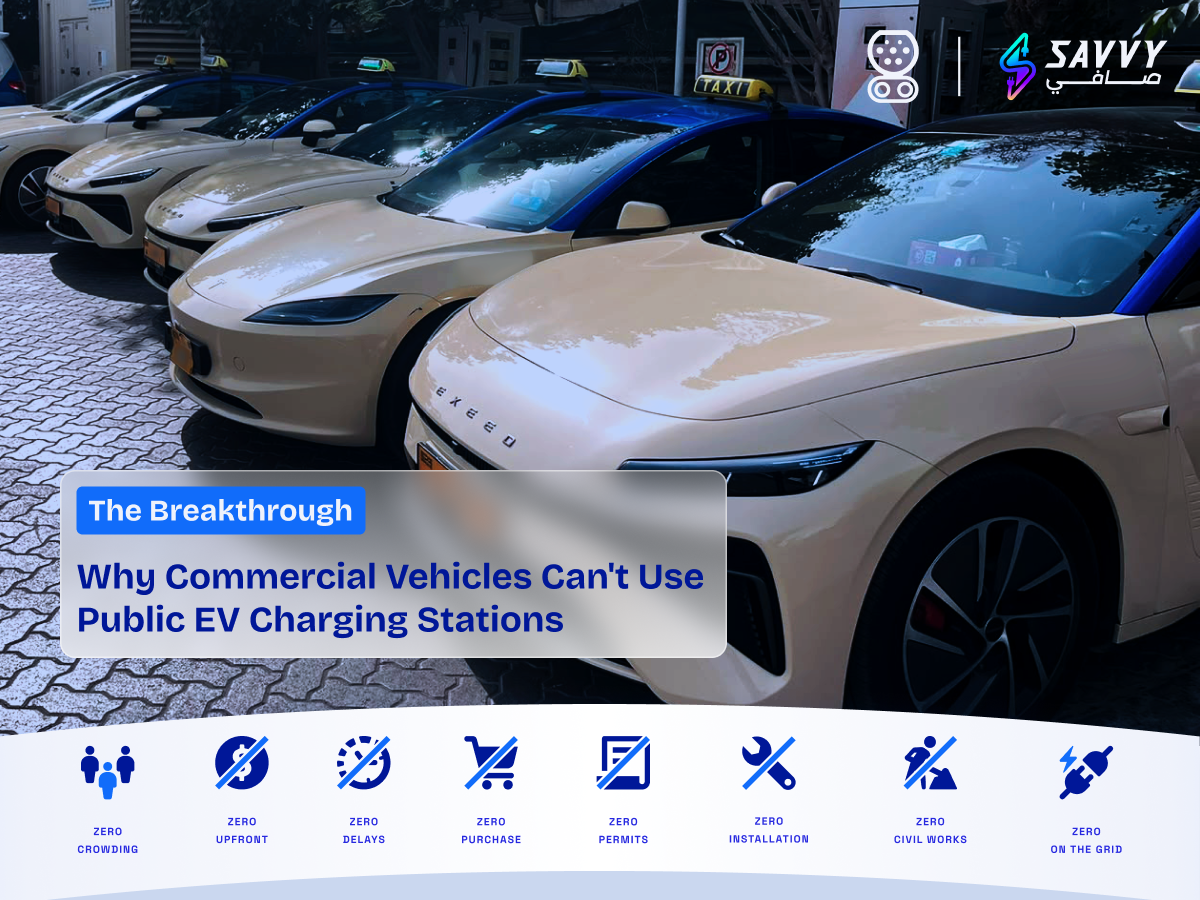
Public EV charging networks have expanded rapidly over the past few years, built primarily around the needs of passenger car drivers who charge occasionally, wait a reasonable amount of time, and then move on. Commercial fleets - delivery vans, box trucks, buses, and heavy-duty freight vehicles - operate on a completely different set of physical, electrical, and economic requirements. The result is a public charging network that, in practice, cannot support most commercial vehicle operations at scale.
This isn't a matter of preference. It comes down to measurable constraints in vehicle size, charging power, network reliability, and operating economics - backed by data from global energy agencies, UK regulators and industry bodies, and the UAE's own charging infrastructure providers.
The Physical Space Problem
Public charging bays are engineered around passenger car dimensions, not commercial vehicles. A typical electric car battery holds somewhere between 40 and 100 kWh, while a large electric HGV battery can hold 300 to 500+ kWh - five to ten times as much energy that needs to move into the vehicle. Charging infrastructure built for heavy goods vehicles has to account for far more than just extra power: vehicle length, height, turning radius, and trailer access all affect whether a site can physically accommodate a truck at all, according to UK charging infrastructure specialists working across the HGV sector.
This is a large part of why so few existing public charging sites can serve commercial vehicles. Sites designed primarily for cars and vans are frequently unable to accommodate trucks even where the power rating looks sufficient on paper, since manoeuvring space, canopy height, and bay length were never planned with a rigid or articulated vehicle in mind.
The Power Gap: Commercial Vehicles Need More Than Most Public Chargers Can Deliver
Even where a heavy vehicle can physically fit, the power available at most public charging sites falls well short of what commercial vehicles need to charge on a workable schedule.
Globally, the International Energy Agency's Global EV Outlook 2026 notes that electric cars capable of using chargers above 250 kW still represent less than 5% of the global vehicle stock, and that the large majority of charging worldwide continues to happen at home or at work rather than at high-power public sites. Public charging networks, in other words, have been built primarily around lower-power, everyday car use - not the high-power, short-dwell-time charging that commercial fleets require.
In the UK, industry analysis shows electric trucks typically require 150 kW to 400 kW today, with the sector moving toward megawatt-level charging as heavier vehicles enter service. Because of this, "car-first" charging infrastructure rarely works well for trucks even when the power rating looks adequate on paper, according to UK fleet charging platform Paua's 2026 assessment of the country's truck charging landscape.
The industry's response has been to build a dedicated charging standard for heavy vehicles: the Megawatt Charging System (MCS). Where the existing CCS fast-charging standard tops out at roughly 350 - 400 kW, MCS is designed to deliver power in the megawatt range for the largest commercial vehicles. The international technical specification for MCS was only finalised in 2026, and public MCS infrastructure is still in its earliest stages of rollout - meaning the charging standard heavy commercial vehicles actually need is not yet something a fleet can rely on at a typical public charging site today.
In the UAE, the pattern is similar. Much of Dubai's public charging network, delivered through DEWA's Green Charger initiative and its licensed partners, is built around standard AC chargers rated up to 22 kW, designed for private vehicles charging overnight. Fleets, taxis, and commercial operators, by contrast, increasingly require DC fast and ultra-fast chargers rated up to 480 kW to achieve workable turnaround times - a significantly different tier of infrastructure than what most public charging points in the region are built to deliver.
Reliability: Public Chargers Fail More Often Than a Business Can Tolerate
For an individual driver, a broken charger is an inconvenience. For a commercial fleet running scheduled deliveries, driver shifts, and customer time windows, it's a direct operational and financial risk.
The UK provides some of the clearest data on this. Under the Public Charge Point Regulations 2023, rapid chargers (50 kW and above) have been required to hit a 99% average annual reliability standard since November 2024. Yet a 2025 survey of over 200 UK charge point operator decision-makers by Monta found that only 3.9% currently meet that threshold. A separate 2026 review of 38 UK rapid charging networks found that just 16 appeared fully compliant with the reliability rules, while 22 did not.
Consumer research tells a similar story. A YouGov survey commissioned by Ctek found that UK EV drivers encounter a faulty public charge point roughly one in every four times they try to charge, and that 52% of UK EV drivers have had to queue to use a public charger, with delays reported on one in every four visits.
For a passenger vehicle owner, this might mean driving to a different charger. For a commercial fleet operating on a fixed schedule, a single failed or delayed charging session can cascade into a missed delivery window, an idle driver, or a vehicle that isn't ready for its next shift—a risk that public infrastructure, even where technically available, isn't built to manage at fleet scale.
The Economics Don't Work at Fleet Scale
Vehicle downtime is already expensive for commercial operators before charging reliability is even factored in. Research commissioned by Mercedes-Benz Vans found that UK businesses lose an average of £1,172 per van, per day, when a vehicle is off the road, with UK fleets experiencing an average of 6.5 days of disruption over a 12-month period. Separate research from Northgate Vehicle Hire put UK light commercial vehicle downtime at a £2.4 billion annual cost nationally, equivalent to roughly £800 for every day a delivery vehicle is unavailable.
Public charging infrastructure also isn't designed around fleet duty cycles. A passenger driver arriving at a charger has flexible timing; a delivery van, taxi, or bus needs to be charged and back on its route within a specific operational window. In the UAE, fleet charging analysis for Dubai's commercial EV sector notes that fleet vehicles typically travel three to five times more kilometres than private cars, making uptime and charging reliability directly tied to revenue in a way that simply isn't true for an everyday private driver.
Why This Points Toward Dedicated and Off-Grid Charging
None of this means public charging infrastructure is poorly designed - it's built to do a specific job well: serve passenger vehicles making occasional, opportunistic stops, largely at home, at work, or on longer personal journeys. Commercial fleets have a different set of requirements: vehicles that are physically larger, need substantially more power delivered on a predictable schedule, and can't absorb the cost of a failed or delayed charging attempt the way an individual driver can.
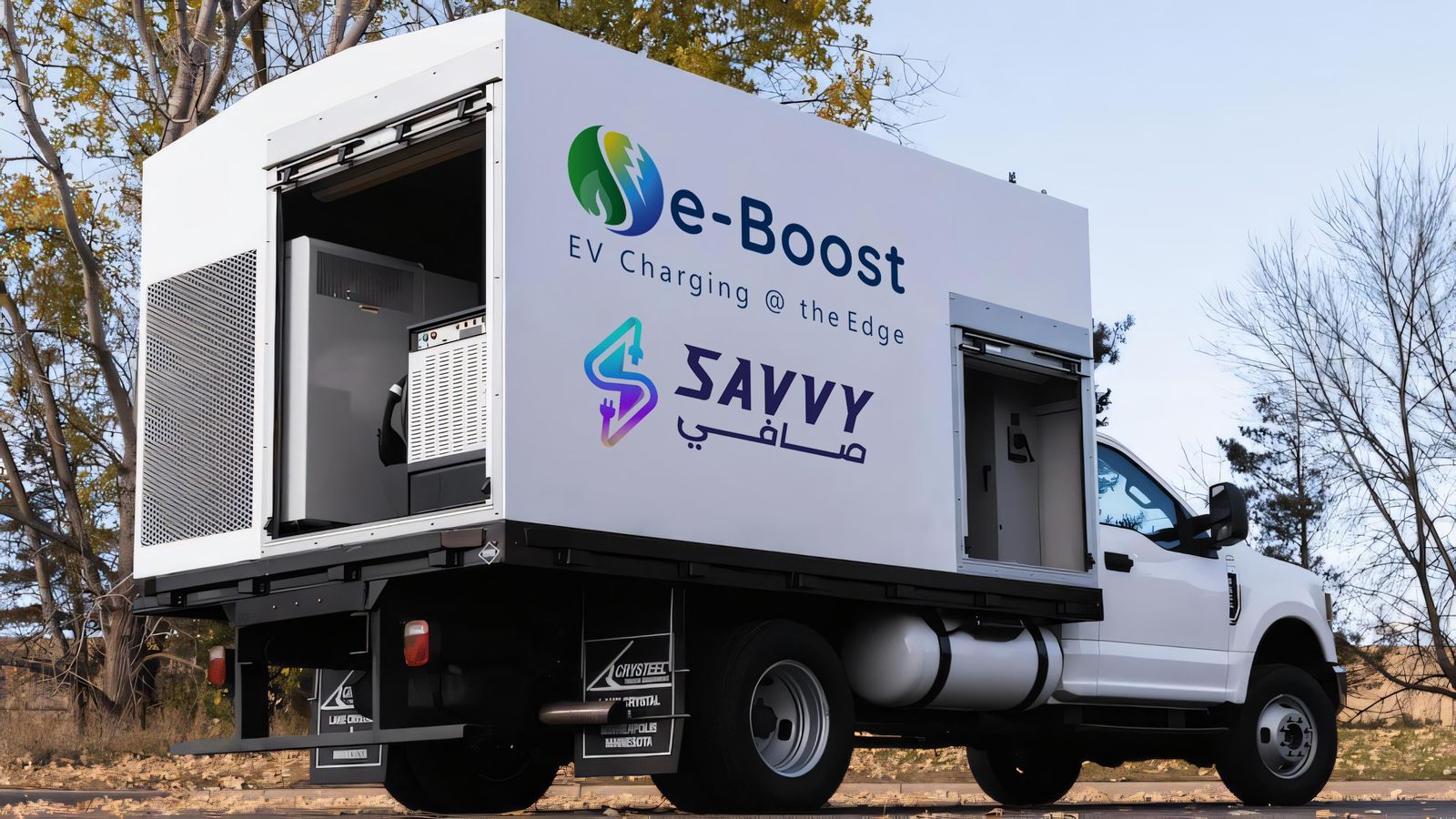
This is why fleet-dedicated charging - whether through private depots, captive charging models, or flexible off-grid and mobile charging systems - has become the default approach for commercial electrification rather than an alternative to public infrastructure. Depot and on-demand charging models let fleet operators control charging schedules, secure the higher power levels commercial vehicles require, and avoid the reliability gaps and physical constraints that currently make most public charging infrastructure unsuitable for anything larger than a passenger car.
Frequently Asked Questions
Can electric trucks use the same public chargers as electric cars? Physically and electrically, usually not. Public charging bays are typically sized for passenger vehicles, and most public chargers deliver far less power than a heavy-duty commercial vehicle can accept, on a standard incompatible with the megawatt-level charging most trucks are being built to use.
Why don't public chargers deliver enough power for commercial vehicles? Globally, fewer than 5% of electric vehicles on the road can use chargers above 250 kW, and most public charging infrastructure has been built around everyday car use. Commercial vehicles increasingly require the Megawatt Charging System (MCS) standard, which is still in the early stages of public rollout.
How reliable is public EV charging infrastructure? In the UK, only 3.9% of surveyed charge point operators meet the government's mandated 99% reliability standard for rapid chargers, and drivers report encountering a faulty charger roughly one in every four visits.
Is public charging suitable for UAE commercial fleets? Much of the UAE's public charging network is built around standard AC chargers rated up to 22 kW for private vehicles. Commercial fleets and taxis typically require DC fast or ultra-fast charging up to 480 kW to maintain workable turnaround times.
What's the alternative to relying on public charging for commercial fleets? Most commercial fleets use dedicated depot charging, captive charging infrastructure, or flexible off-grid and mobile charging systems that can be deployed to match fleet schedules, vehicle sizes, and power requirements without depending on shared public infrastructure. Learn more about how Savvy Energy supports fleets with these solutions.
Tags: ev charging, fleet, commercial vehicles, mcs, dubai, uk